Start With the Frequency Range
When someone asks for the best EMI gasket material for a high-frequency application, it’s usually because of a real design problem. A product needs to pass testing. A seam is leaking. Sensitive electronics sit near RF activity, and the team needs a gasket direction before the next design review, prototype build, or purchasing decision.
The phrase sounds specific because it uses technical language. The problem is that “high frequency” does not define the requirement. “Ultra high frequency” creates the same problem when used as a broad label rather than a measurable range. At JEMIC, the better starting point is the actual frequency range, stated in MHz or GHz, along with the attenuation target and the application details needed to review the gasket correctly.
Why Engineers Buy Into the Language
High-frequency and ultra-high-frequency sound are precise engineering categories. That is why people use them. The language is more specific than “RF shielding,” and it gives buyers a way to describe a problem before all the technical details are known. It also appears in product language, spec conversations, and purchasing requests, so it starts to feel like a complete requirement.
The issue is that people use those terms differently. One customer might say “high frequency” while talking about Bluetooth or Wi-Fi. Another might use the same phrase for microwave, radar, aerospace, or defense work. A third might say “ultra high frequency” because the project sounds more demanding, not because a defined operating band has been identified.
Formal frequency language shows why those labels need clarification. The International Telecommunication Union’s 2015 recommendation, ITU-R V.431-8, defines HF as 3 to 30 MHz, SHF as 3 to 30 GHz, and EHF as 30 to 300 GHz. That does not match the loose way many buyers use “high frequency” in gasket conversations. Once the same phrase covers several possible ranges, it ceases to function as a technical requirement.
Real wireless examples make the gap even clearer. Bluetooth uses the 2.4 GHz ISM band. The Federal Communications Commission’s 2020 6 GHz order addresses Wi-Fi activity in the 2.4 GHz and 5 GHz bands, and opens 5.925 to 7.125 GHz for 6 GHz unlicensed use. In other shielding conversations, the range might be much higher, closer to 18-40 GHz. Those are not the same problems, and they do not lead to the same gasket review.
What Actually Matters
A useful conversation starts when the language becomes measurable requirements. A label points in the general direction, but a frequency range gives us something to evaluate. That range helps narrow the material discussion, the shielding target, and the type of performance data that matters. The question moves from “What sounds high frequency?” to “Where does the gasket need to perform?”
The Actual MHz or GHz Range
The first thing we need is the frequency range. Not a category. Not a phrase. The actual operating band, test range, or signal concern gives the request a technical anchor. A customer requesting a high-frequency EMI gasket might mean 2.4 GHz, 5 GHz, 6 GHz, or a much higher microwave frequency, and each version points to a different review process.
This is why a stronger request starts with a number. “We need shielding around 5 GHz” gives us more to work with than “we need a high-frequency gasket.” “We need attenuation across this defined range” gives us more again because it turns the request into a measurable shielding problem. The words matter less than the range.
The Required Attenuation
Frequency tells us where the gasket needs to perform. Attenuation indicates how much reduction the application requires. An EMI gasket does not simply “block” a frequency in the abstract. It reduces electromagnetic energy by a measured amount under defined conditions, and that reduction is usually discussed in decibels. This is also why published shielding-effectiveness language should be read as application-dependent performance information, not a blanket result for every enclosure, gasket shape, compression condition, or installation.
A request tied to both frequency and attenuation gives the engineering conversation a target. It helps separate a general RF concern from a defined shielding requirement. It also prevents the buyer and manufacturer from talking past each other. If the customer only says “ultra-high frequency,” we still do not know how much performance the application needs.
| Common wording | Useful engineering detail |
| We need a high-frequency EMI gasket. | The application operates around a defined MHz or GHz range. |
| We need an ultra-high-frequency gasket. | The gasket needs to be reviewed across a specific operating band or test range. |
| We need the best material. | The design needs a defined attenuation target in dB. |
| It needs to block RF. | The concern is Bluetooth, Wi-Fi, cellular, radar, or another defined signal range. |
| It has to pass testing. | The project has a specific test method, standard, or documentation requirement. |
That difference matters because some projects need a working material direction, while others need performance language tied to a test method, an agency requirement, or a procurement document. Those projects should not start with a material name alone. They should start with the range, the attenuation target, and the standard or test expectation that will be used to judge the result.
Why Test Data Still Needs Application Context
Material data matters, but material data answers only one part of the question. ASTM D4935-18, published by ASTM International in 2018, addresses shielding-effectiveness testing of planar materials under specified conditions. That is useful for understanding material behavior, but a flat material sample is not the same as a finished gasket inside a joint. Treating those as the same result creates confidence the assembly has not earned.
IEEE 1302-2019, published by IEEE, focuses on electromagnetic characterization of conductive gaskets from DC to 40 GHz. That distinction matters because a gasket is not only a material. It is a material used in a contact interface, with compression, surfaces, geometry, and installation conditions affecting the result. Once the material becomes a gasket, the question changes from material behavior to installed shielding performance.
A finished enclosure creates another layer. Seams, fasteners, openings, pressure, and contact surfaces all influence performance. Material testing, gasket characterization, and enclosure behavior are related but not interchangeable. The material report helps narrow the answer. It does not finish the answer.
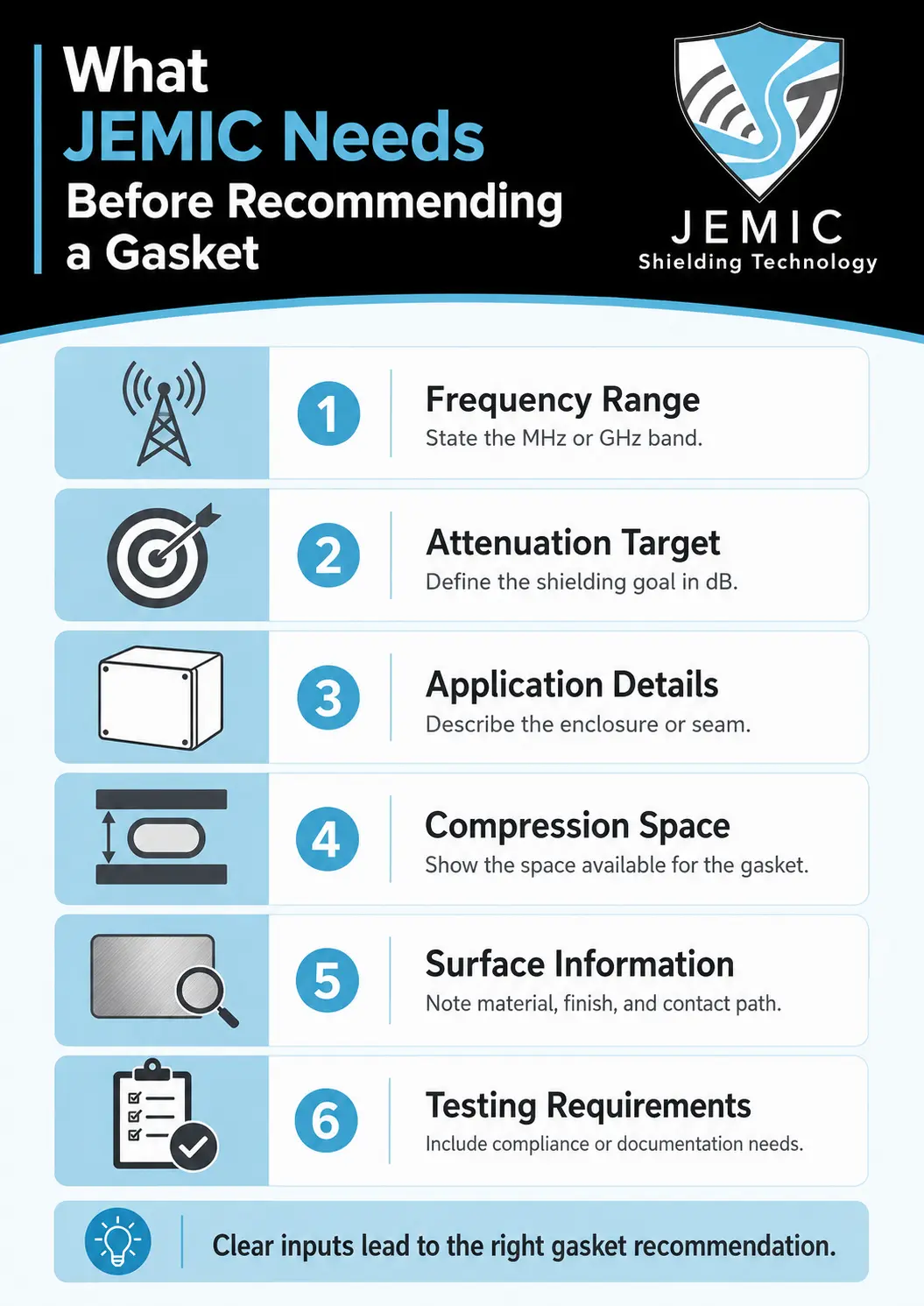
What JEMIC Needs Before Recommending a Gasket
A useful EMI gasket recommendation starts with well-defined inputs because shielding effectiveness is not determined by material alone. When the request includes only “high frequency” or “ultra high frequency,” we still have to translate the language into engineering requirements before recommending material. Frequency range, attenuation target, gasket geometry, compression, enclosure surface, and testing expectations all affect the final recommendation. A published shielding value provides a starting point for the conversation, but the right gasket still needs to match the actual use case.
Before we recommend a gasket direction, we need:
- Frequency range in MHz or GHz.This defines where the gasket needs to perform and keeps broad language from driving the material decision.
- Attenuation target in dB.Frequency indicates the range, while attenuation indicates the level of shielding performance the design requires.
- Application or enclosure details.A fixed seam, a removable cover, an access panel, or an enclosure joint creates different contact conditions.
- Available compression space.A gasket needs enough compression to maintain contact, but the assembly also has physical limits.
- Surface or interface information.The enclosure material and finish affect whether the gasket has a conductive path.
- Testing, documentation, or compliance requirements. Defense, government, aerospace, medical, and other controlled applications often need recommendations tied to verification expectations, not only material selection.
These are not extra details. They are the information that turns “best EMI gasket material” into a real specification. JEMIC’s EMI gasket specifications note that certain gasket applications can see shielding effectiveness greater than 85 dB attenuation from 20 MHz to 10 GHz. That is useful performance language, but it should not be treated as a universal result for every gasket shape, enclosure, compression condition, or installation. The same conversation still needs to lead back to the real application: frequency range, attenuation target, contact surface, compression space, and testing expectations.
The Right Gasket Starts With the Right Question
The best EMI gasket material for a high-frequency or ultra-high-frequency application cannot be selected from those words alone. Those labels are starting points, not specifications. The better question is more direct: what frequency range needs shielding, how much attenuation is required, and what test or application details will define success?
If you know the frequency range and attenuation target, send those details with your enclosure information, contact surface, compression limits, and testing requirements. If you only know that the application is “high frequency” or “ultra high frequency,” start there, but expect the next step to be definition. For general EMI gasket specifications, profile options, and material direction, review JEMIC’s EMI gasket page before sending application details. The goal is not to sound more technical. The goal is to define the requirement clearly enough to choose the right gasket material.
Define the range. Define the performance target. Show us the application. That is how the right EMI gasket recommendation starts.