A Faraday bag can use capable shielding material and still be the wrong bag for the job. If the device barely fits, the opening must be stretched, or the closure cannot be secured consistently, the bag will become a problem during actual use. That problem compounds when an organization deploys dozens of bags across a security team, evidence unit, or controlled facility. Performance matters, but performance begins with selecting a bag that people can use correctly every time.
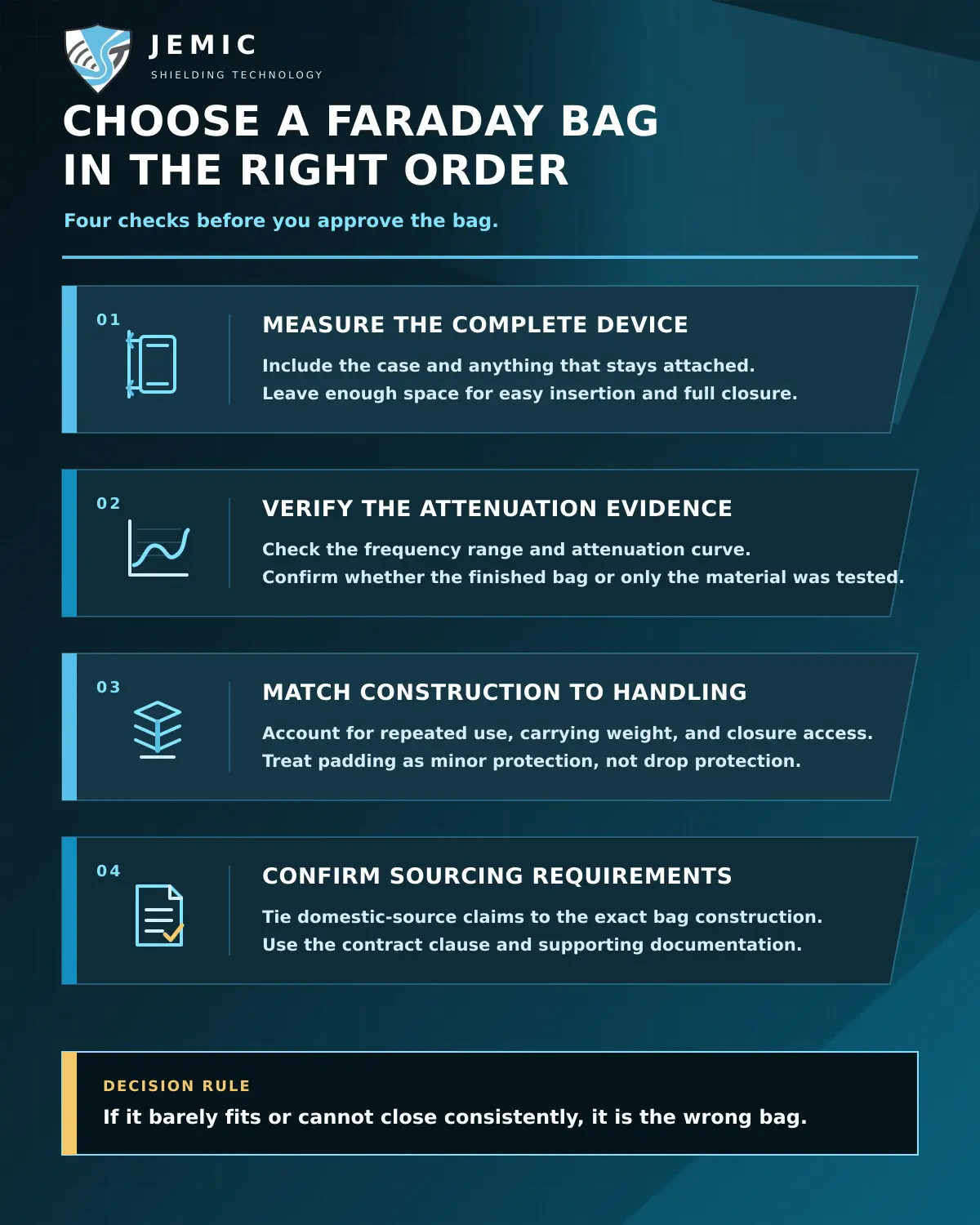
The selection process should therefore follow a practical order. Start with the device’s complete dimensions, including anything that will remain attached when it enters the bag. Once fit is established, evaluate attenuation across the frequencies relevant to the application. Construction, carrying weight, and sourcing requirements can then be considered without losing sight of the bag’s primary job.
Start With the Device, Not the Bag Category
Size is the first decision because product categories are less precise than they appear. Two phones can have different dimensions even when their screens are marketed as the same size, and a protective case can add enough thickness to change how the device passes through the opening. Laptop screen size poses a similar problem because it does not account for the chassis dimensions. The buyer needs to measure the device that will enter the bag, not rely on the description printed on its box.
A small amount of extra space is generally preferable to a fit that is technically possible but difficult to use. We have handled older phone bags that could still accommodate a newer device, but inserting and removing it became an unnecessary struggle. That inconvenience can prompt users to rush the closure or avoid the bag when time is of the essence. A properly sized bag should allow the device to enter without force while preserving enough material to close the opening as designed.
JEMIC organizes its standard options around three practical device categories, with custom sizing available when the equipment falls outside those ranges.
| Bag category | Typical application | Dimension that matters most |
| Cell phone bag | Phones, smartwatches, key fobs, and other small wireless devices | Complete length, width, and thickness with the case installed |
| Tablet bag | Tablets and intermediate-sized electronics | Device thickness and the bag’s usable opening |
| Laptop bag | Most portable 13-inch laptops | Full chassis dimensions rather than advertised screen size |
| Custom bag | Larger laptops, unusual equipment, or multiple devices | Total contents, required opening, closure allowance, and order quantity |
Larger laptops demonstrate why category names should never replace measurements. A standard mobile laptop bag may accommodate many 13-inch machines, while a 17-inch laptop can require a substantially different pattern. Increasing the exterior dimensions alone does not resolve the problem because the opening, seams, closure allowance, and material usage must also change. When standard dimensions do not provide comfortable clearance, a custom bag is usually more practical than forcing an expensive device into an undersized product.
Read Attenuation Data in Context
Shielding effectiveness is the most important technical comparison after fit, but a headline decibel rating does not provide enough information to support a purchase. Attenuation varies with frequency, so a strong result at one test point cannot be automatically applied across cellular, Wi-Fi, Bluetooth, GPS, or other bands. The test configuration also matters because raw shielding material and a sewn bag are not the same test article. A useful report identifies the frequency range, test method, sample construction, and closure condition that produced the result.
That distinction is reflected in the scope of ASTM D4935-18(2024), a current standard method for measuring the electromagnetic shielding effectiveness of planar materials. A material test can help characterize the conductive fabric used in a bag, but it does not automatically establish the finished product’s performance. Sewing introduces seams, while the opening and closure create additional variables that a flat material sample does not contain. Buyers should therefore determine whether an advertised result applies to the shielding material, the assembled bag, or both.
A useful technical review should answer several questions before the attenuation figure is accepted:
- What was tested?Identify whether the sample was a piece of shielding material or a complete finished bag.
- Which frequencies were covered?Confirm that the test range includes the signals relevant to the device and operating environment.
- How did performance change across that range?Review the attenuation curve rather than relying on the highest number in the report.
- How was the bag closed?Confirm that the test used the same closure condition expected during normal operation.
- Who performed the test?Record the laboratory, method, test date, and sample identification.
- What does the result apply to?Avoid extending one sample’s result to different sizes, materials, closures, or constructions without supporting data.
A test facility provides measured data for a specific sample under defined conditions. That evidence is more useful than an unsupported promise that a bag “blocks everything,” but it is not a permanent guarantee across all frequencies and use conditions. Changes in materials or construction can affect the result, and repeated handling can introduce wear that was not present in the original sample. At JEMIC, we treat attenuation data as a means of matching the bag to the requirement rather than as a single marketing number.
 Match the Construction to Daily Use
A bag that performs well in a controlled test still has to function within the buyer’s operating process. An evidence team may open bags during field collection, while a security department may distribute them before meetings and recover them afterward. Those situations place different demands on weight, handling, and durability. The right construction is the one that preserves shielding while remaining practical for the people who use it.
Weight becomes more important as device size and bag quantity increase. Within comparable constructions, additional shielding material may improve performance while adding ounces to the finished bag. That difference may be minor for one phone pouch, but more noticeable when a team carries several laptop bags with equipment already inside. The objective is not to purchase the heaviest bag available; it is to obtain the required attenuation without adding weight that does not serve the application.
Padding also needs to be evaluated in terms of what it can realistically accomplish. A padded construction can reduce scratching and protect against light contact, such as one device pressing against another during storage or transport. It should not be treated as drop protection for a laptop or forensic device. When significant impact protection is required, the buyer should use a separate protective case and size the Faraday bag around the complete protected assembly.
Repeated use places additional importance on the opening and closure. A closure that performs properly only when handled with unusual care is difficult to deploy across a large group. Users should be able to recognize when the bag is fully closed and repeat the same procedure without improvising. Fit, opening design, and closure condition therefore belong in the same purchasing decision rather than being treated as separate conveniences.
Confirm Sourcing Requirements before Ordering
Government and defense buyers may have domestic-sourcing obligations that commercial buyers do not face. “Made in the United States” can be an important starting point, but it should not automatically be treated as proof that every contract requirement has been satisfied. The current Defense Federal Acquisition Regulation Supplement applies the Berry Amendment to specified domestic products and materials and identifies exceptions and acquisition thresholds. The applicable solicitation and contract clauses must determine what documentation the buyer requests.
JEMIC’s U.S.-based manufacturing approach gives government and institutional customers a domestic production path that many inexpensive imported bags cannot provide. That distinction is relevant when a contract restricts sourcing or when an organization wants clearer control over where it’s shielding products are produced. It does not eliminate the need to review the purchase requirements, but it provides the buyer with a supplier who can discuss construction and sourcing at the product level. Price can then be considered alongside fit, tested performance, and procurement eligibility, rather than serving as the sole comparison.
Choose a Bag People Can Close Correctly Every Time
The right Faraday bag is neither the smallest bag a device can be pushed into nor the one displaying the largest isolated attenuation number. It is a bag that comfortably fits the complete device, consistently closes, and includes testing relevant to the frequencies the organization needs to control. Weight, padding, and domestic sourcing should support that requirement rather than distract from it. Tell JEMIC what devices you need to shield, their complete dimensions, how many bags you require, and whether the purchase includes domestic-source provisions. We can determine whether a standard phone, tablet, or laptop bag fits the application or whether a custom size deserves consideration.