 A secure meeting is only as controlled as the devices inside the room. Phones are not only personal items sitting in someone’s pocket. They are wireless devices with cellular, Wi-Fi, Bluetooth, GPS, RFID, and NFC pathways. When a phone enters a sensitive meeting, the room may be private, but the device can still communicate.
That creates a practical problem for companies, schools, agencies, and secure facilities. A locked room controls access to the space. It does not control the phones inside it. A phone policy asks people to follow a rule. A Faraday bag gives the organization a physical step for handling employee, visitor, contractor, or guest devices before sensitive work begins.
At JEMIC, we view Faraday bags as part of a broader phone-control process. The issue is not personal phone privacy. The issue is repeatable control. A company does not need a one-off travel pouch. It needs a clear process for handling phones in secure rooms, with products built for repeated use, secure storage, and institutional needs.
Why Employee Phones Create a Security Problem in Secure Rooms
Employee phones pose a security problem in secure rooms because they remain wireless endpoints even when not in use. A phone brought into a sensitive meeting still has signal pathways unless the organization has a physical way to isolate the device before the meeting begins.
This is where enterprise mobile security matters. NIST SP 800-124 Rev. 2 explains that mobile devices have moved from personal communication tools to permanent fixtures in enterprise environments. NIST also explains that these devices access modern networks and systems and process sensitive data.
That point changes how companies should think about phones in secure meetings. The phone is not a convenience issue. It is part of the security environment. A company may control the room, attendee list, documents, and network while still allowing unmanaged wireless devices to operate within the space.
The risk becomes more serious in meetings involving:
- Executive decisions
- Mergers and acquisitions
- Legal strategy
- Product development
- Government contracts
- Internal investigations
- Evidence review
- Security planning
- Board-level discussions
- Sensitive school or institutional meetings
The problem is not always intentional misuse. A phone does not need someone actively using it to remain a wireless device. That is why secure-room phone control needs more than etiquette. “Turn your phone off” is a request. “Place the phone in a Faraday bag before entering the meeting” is a procedure.
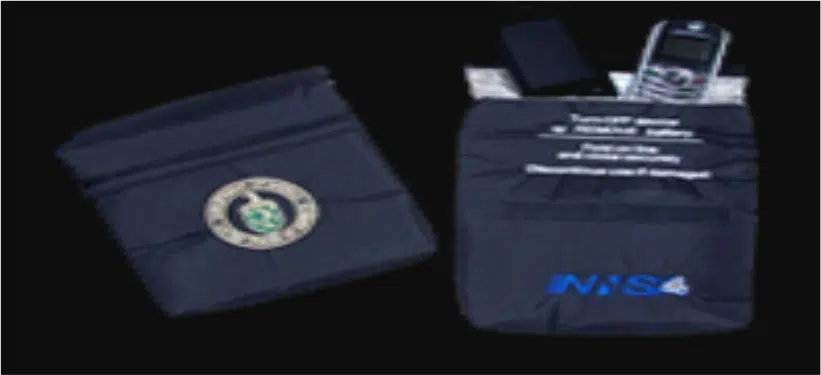
Our RF cell phone bags address this problem because they are designed to prevent RF signals from being transmitted to or from a phone inside the bag.
A Faraday Bag Turns a Phone Rule Into a Physical Process
A phone policy depends on people following directions. A Faraday bag changes the control point from behavior to process.
That difference matters. A company should not assume every attendee has powered down a device. It should not assume every guest has disabled Bluetooth or Wi-Fi. It should not assume a contractor’s phone follows the company’s mobile device management rules. It should not assume a visitor’s device is configured safely.
NIST SP 800-124 covers both organization-provided and personally owned device scenarios. That supports the core issue for secure meetings. Companies often deal with mixed device ownership, varying management levels, and varying trust levels within the same room.
A Faraday bag gives the company one standard step across those devices. The phone goes inside the shielded bag. The meeting starts after the device is isolated. The process no longer depends only on the user’s settings, honesty, or technical knowledge.
How Companies Use Faraday Bags Before a Sensitive Meeting Starts
The most important part of a Faraday bag program happens before the meeting starts. This is where the company defines the room, the rule, the handoff, and the person responsible for enforcement.
A strong room rule is simple: All phones and wireless devices must be placed in a Faraday bag before entering this meeting space.
That rule should apply to employees, executives, outside counsel, vendors, guests, contractors, board members, and visitors. Secure meetings lose consistency when senior people or outside guests receive informal exceptions.
A practical intake process looks like this:
- Identify the devices covered by the rule
- Provide the Faraday bag at the room entry point
- Have the attendee place the phone inside the bag
- Confirm the bag is closed before the attendee enters
- Decide whether the attendee keeps the bag or leaves it at a controlled location
- Return devices after the meeting ends or after the attendee exits the controlled space
Our Faraday bags should not be treated as personal travel accessories in this setting. They should be used as tools for room-entry control.
Where Faraday Bags Fit Best
Faraday bags fit best when the organization needs flexible, temporary phone isolation. They work well when devices move with people, meetings change rooms, or security teams need a portable control.
The right product depends on how the room operates. Some organizations need individual Faraday bags for meetings and visitors. Others need fixed storage when many people enter the same controlled area every day. Larger or more unusual projects may need custom shielding support.
| Secure-room situation | What the organization needs | Best JEMIC path |
| Executive, board, or legal meetings | A simple way to isolate phones before confidential discussion starts | Faraday bags |
| Visitor, contractor, or vendor meetings | One phone-control step that does not depend on the visitor’s device settings | Faraday bags |
| Evidence intake or field handling | Temporary signal isolation while a device moves between locations or custody points | Faraday bags |
| Schools, offices, or secure facilities with repeated entry | A fixed check-in and release process for many devices | Shielded lockers |
| Large device counts, unusual sizes, or special room requirements | A product path built around the facility, device type, or operating process | Custom shielding support |
This table is meant to prevent the wrong starting point. A Faraday bag is the better fit when the company needs flexible phone isolation around a meeting, visitor, investigation, or temporary secure space. A shielded locker is a better fit when the same location needs repeated device collection. Custom shielding support becomes more relevant when standard products do not match the device size, quantity, room setup, or security process.
Our RF cell phone bags use two layers of RF shielding material under a foam-padded outer layer. We also offer three sizes, with custom sizes available upon request.
That matters because secure meetings rarely use a single device type. A practical process may need to account for phones, larger phones, small tablets, smartwatches, key fobs, or other wireless items.
Talk to JEMIC About Faraday Bags for Secure Rooms
A secure room needs more than a phone rule. It needs a consistent way to handle phones before sensitive work begins.
We give companies several paths. Faraday bags support flexible signal isolation for meetings, visitors, investigations, and temporary secure spaces. Shielded lockers support repeated phone storage in schools, workplaces, secure locations, government buildings, and law enforcement settings. Custom shielding support gives buyers a path when standard products do not fit the room, device count, or operating process.
For a boardroom, evidence room, school phone-control program, government facility, or restricted workplace, the best starting point is the room protocol. Once the organization defines who enters the room, how many devices need to be controlled, where phones should stay, and how often the process repeats, we can help match the Faraday bag, shielded locker, or custom shielding option to the way the space needs to operate.