Not every EMI gasket shielding project begins with a finished drawing, a material specification, and a production quantity. Sometimes a customer comes to us with something much less defined: a signal is getting through, a component is experiencing interference, or an existing shielding approach is not producing the expected result. In those situations, the first step is not necessarily choosing a product from a catalog. We need to understand what is happening, what the customer needs the shielding to accomplish, and whether we can develop a practical way to get there.
That is where research and development becomes part of our work at JEMIC. We regularly work with customers who understand their equipment and their application but are not EMI engineers, which means they may know the problem without knowing exactly what shielding method will solve it. Our job is to translate the application into a shielding requirement we can evaluate. From there, we can determine whether an existing capability applies or whether the project will require testing, custom tooling, a new process, or another form of development.
Custom EMI Gasket Shielding R&D: It Starts with Understanding the Problem
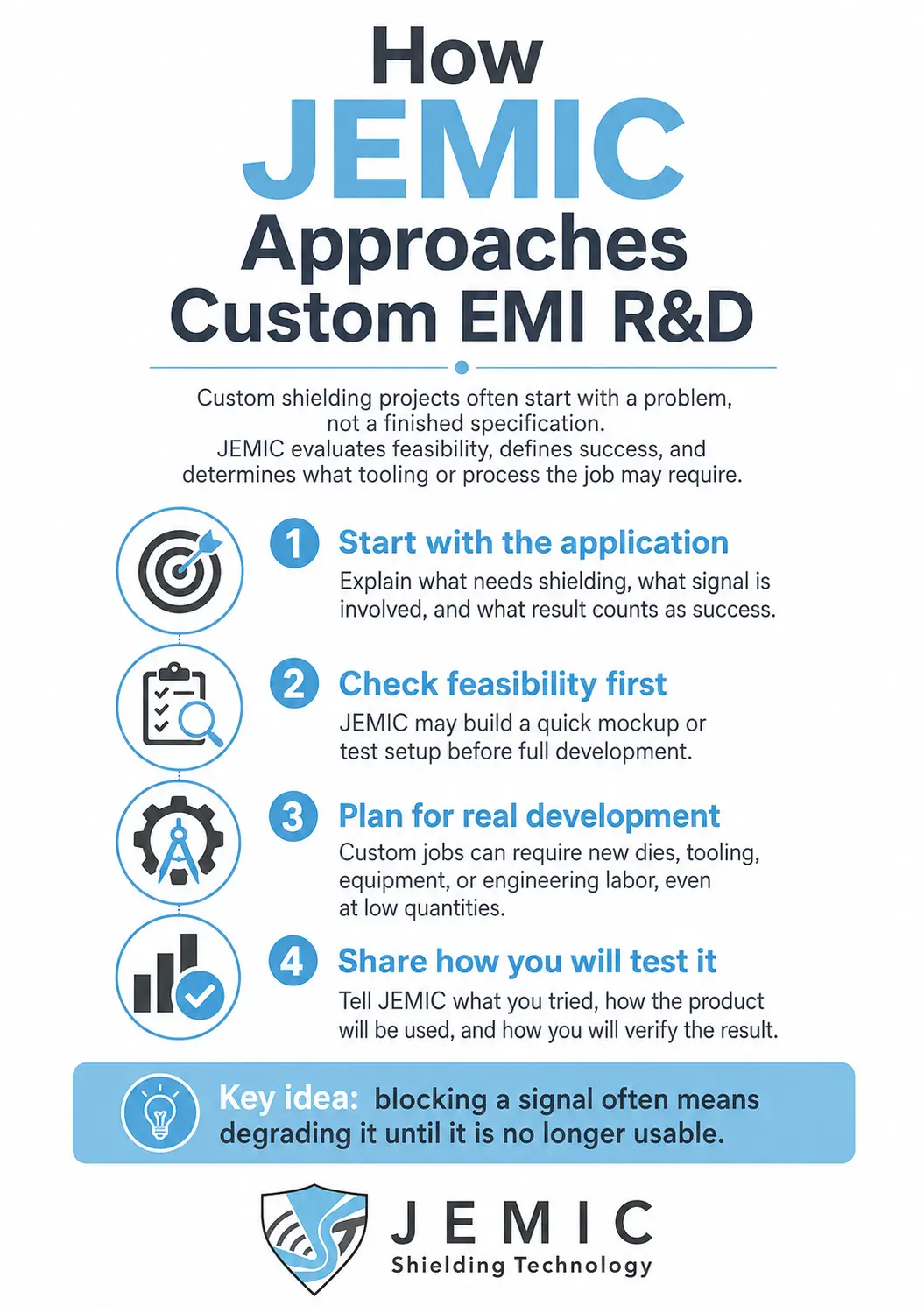
A customer does not need to arrive at JEMIC knowing the exact construction of the solution. In fact, many customers who contact us are trying to resolve an EMI issue precisely because the correct approach is not obvious to them. They may ask for a particular pouch, cable shielding configuration, gasket, or other component, but the requested product is only one part of the conversation. We also need to understand what the customer is trying to accomplish with that product and how it will function in the actual application.
That distinction becomes important when the requested solution and the underlying problem are not necessarily the same thing. If someone asks us to shield a wire assembly, for example, simply confirming that we can put shielding around a wire does not answer whether the finished assembly will perform as the customer needs it to. We need to understand where the interference is occurring, how the part will be used, and what result will count as success. This is why custom shielding work often begins as an engineering discussion rather than an immediate production quote. The better we understand the application at the beginning, the better we can determine what development work is actually necessary.
JEMIC May Test Feasibility before Developing the Full Solution
Before investing in a complete manufacturing process, we may first need to answer a simpler question: Can we make the concept work? Depending on the project, that can mean creating a quick mockup and testing the basic shielding approach before developing the finished product. If a customer needs a pouch to prevent a particular signal from remaining usable, for example, and we can generate that signal in-house, we may build a makeshift version of the pouch around the device and see what happens. The mockup does not need to resemble the finished product, as its purpose is to evaluate feasibility.
That early test can prevent both JEMIC and the customer from investing heavily in a concept that cannot produce the required result. If the initial approach cannot achieve the necessary shielding, it is better to learn that during a quick feasibility test than after custom tooling, materials, and production time have been committed. If the concept works, we can then move into the more detailed questions of construction, repeatability, and manufacturing. The amount of testing required will depend on the project, but the principle is straightforward: prove what we reasonably can before developing more than the application requires.
 Why a Small Custom Job Can Require Significant Development
One of the biggest misunderstandings surrounding custom EMI work is the assumption that a small production quantity automatically means a small project. The customer may need only five, ten, or twenty pieces, but JEMIC may still have to develop the process to produce them. A custom job can require a new die, a purpose-built piece of equipment, engineering time, or substantial manual labor. None of those requirements disappear simply because the final quantity is low.
We have seen this directly with requests such as custom shielding for wire looms. In one case, the customer needed only approximately five shielded parts, but establishing the manufacturing process for those parts could have put the project in the $5,000 to $10,000 range. That was not the price of five ordinary pieces multiplied by five; it reflected the work required to create a process that did not already exist. Depending on the application, people may need to spend a week or more developing equipment or completing work manually if custom equipment is not built. This is why an apparently simple request can become a meaningful R&D project once we determine what is required to manufacture it correctly.
Where practical, we would generally prefer to create a repeatable process rather than solve the same manufacturing problem from scratch every time an order is returned. If a custom die or piece of equipment is developed for the initial order, that capability already exists when the customer needs additional production. The development burden is therefore different from the cost of simply producing another finished part. Understanding that distinction early helps customers evaluate whether the project makes sense at the quantity they need today and at the quantities they may need later.
“Blocking a Signal” Has to Be Defined
Another common problem is that the word “block” can sound much more absolute than the application actually requires. A customer may tell us that a signal needs to be blocked, but the engineering objective is not always to reduce it to a theoretical zero. In many real applications, the requirement is to degrade the signal until the device can no longer use it effectively. What matters is whether the shielding produces the required functional result.
That means JEMIC needs to know more than the name of the signal or device involved. We need to understand what the customer considers a successful test and under what conditions that test will take place. A product that appears to satisfy one test method may not satisfy a completely different test that was never discussed during development. Defining the target upfront gives our engineers something meaningful to design and test against. It also helps avoid the situation where the customer and JEMIC are technically discussing the same word, such as “blocked,” while expecting two different outcomes.
What JEMIC Needs to Know Before R&D Begins
Customers do not need to solve the engineering problem before contacting JEMIC, but they do need to help us understand how the shielding will actually be used and evaluated. A request such as “we need to block this signal” gives us a starting point, but it does not necessarily tell us enough to reproduce the problem, develop the right approach, or test whether that approach worked. Three pieces of information are particularly valuable at the beginning of a custom project: what has already been attempted, how the finished solution will be used, and how the customer intends to test it. Together, those details give our engineers a much clearer definition of the problem we are being asked to solve.
| What JEMIC Needs to Know | Why It Matters | Useful Information to Share |
| What have you already tried? | Previous attempts can show us what has failed, what produced partial results, and where the problem may still exist. | Materials, shielding methods, prototypes, previous configurations, and the results you observed. |
| How will the finished solution be used? | The real application can affect the design, materials, construction, and type of solution that makes sense. | Where it will be used, what it will shield, how it will be handled, and any important operating conditions. |
| How will you test whether it worked? | JEMIC needs to understand the customer’s definition of success so we can develop and test toward the same objective. | The signal, device, equipment, test method, and conditions you will use to evaluate the finished product. |
The testing question can be especially important because it may change what we evaluate during development. We previously worked on shielded lockers for a customer who later tested them with an AirTag, but that specific test was not part of the original discussion. If we had known that an AirTag would be used to evaluate the finished lockers, we could have incorporated one into our own testing before the lockers were shipped. That additional information could have prevented unnecessary shipping, retesting, and additional work after delivery. Customers do not need to arrive with a complete engineering specification, but JEMIC does need to know enough about the real application to develop and test toward the result the customer actually expects.
Bring JEMIC the Shielding Problem
EMI Gaskets and Shielding is a science. Custom EMI shielding does not always begin with knowing which material, product, or manufacturing process you need. It can begin with knowing what is not working and giving our engineers enough information to investigate why. JEMIC can evaluate the application, determine whether a shielding concept is feasible, and identify the development, tooling, or manufacturing work required to turn that concept into a finished solution. If you are dealing with an unusual EMI shielding problem, contact JEMIC with what you have tried, how the finished solution will be used, and how you plan to test it so we can begin with the right problem.