

 When law enforcement officials seize a smartphone during an arrest, the critical data it contains could mean the difference between securing justice and losing key evidence forever. Imagine a scenario where authorities recover a suspect’s phone containing communications or location details essential for prosecution, only to find that crucial data has been erased remotely. Digital evidence today isn’t just files on a computer—it’s real-time communication, location data, and multimedia files. Its integrity can vanish instantly if not handled correctly.
In the digital age, preserving data integrity during investigations is paramount. Courts and criminal investigations increasingly rely on digital evidence, making it essential to adopt foolproof methods for preservation. While there are various ways to protect data on confiscated devices, one technology often stands out for its simplicity and reliability, the Faraday bag. But the critical question remains: can a Faraday bag truly provide complete protection against data destruction and tampering?
Why Data Protection is Critical in Digital Forensics
In law enforcement and cybersecurity, data preservation isn’t merely important, it is fundamental. Consider the moment when authorities first apprehend a suspect and seize their smartphone. The clock starts ticking immediately. Criminal associates may quickly initiate remote data deletion, while some phones could even be preset to delete messages after a fixed period. Each second that data remains unsecured is a gamble, potentially jeopardizing entire cases.
The digital landscape is fraught with risks to evidence integrity, including:
- Remote wiping:Criminal associates may remotely trigger data deletion once they learn of an arrest.
- Self-destructive apps:Apps like Snapchat, Wickr, or TigerText automatically delete data after short intervals.
- Tampering risks:Digital evidence is susceptible to alteration if not swiftly secured, undermining its credibility in court.
These threats underscore the urgent need for immediate and reliable data preservation.
Understanding Faraday Bags and Their Functionality
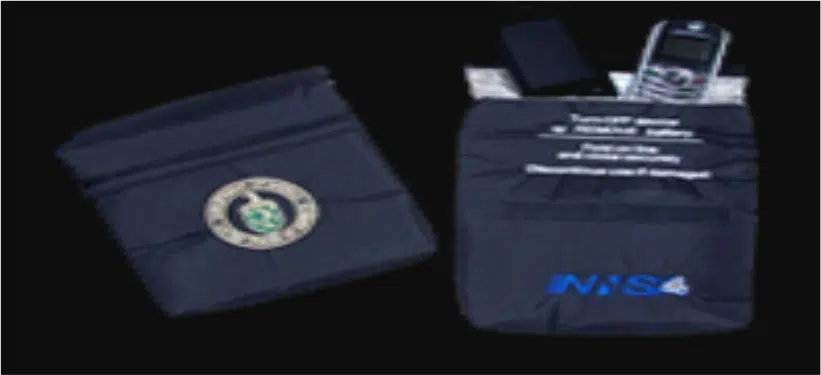
Faraday bags operate on a simple yet powerful scientific principle: electromagnetic shielding. They are specifically designed to block radio frequency signals from reaching the devices inside. By isolating smartphones from external electromagnetic interference, Faraday bags prevent any remote commands—such as wiping, altering, or encrypting data—from affecting the device.
A typical Faraday bag consists of layers of metal-lined fabric, primarily composed of conductive materials like aluminum or copper mesh. These layers form a continuous barrier that disrupts incoming and outgoing electromagnetic signals. Simply placing a phone inside a properly sealed Faraday bag immediately cuts off its communication capabilities, effectively “freezing” the device in the state it was seized.
Evaluating Effectiveness: Science and Real-World Applications
Independent studies and practical experiences strongly support Faraday bags as effective tools for data preservation:
- Scientific validation:Laboratory tests confirm Faraday bags block nearly 100% of electromagnetic signals across common cellular, Wi-Fi, Bluetooth, and GPS frequencies.
- Real-world use:Law enforcement agencies widely utilize Faraday bags during digital evidence seizures. The Department of Justice explicitly recommends their use to prevent data loss or deletion.
- Immediate isolation:Practical field tests show that phones placed in Faraday bags instantly lose communication capability, preventing remote interference.
Yet, even with scientific backing, Faraday bags do not guarantee protection against every scenario, particularly for data programmed to auto-delete at specific intervals. These apps rely on internal timers rather than external signals, making them immune to external electromagnetic shielding. This highlights the need for comprehensive forensic practices; Faraday bags represent a critical part of a broader preservation strategy.
The Essential Role of Faraday Bags in Evidence Security
Given their affordability, ease of use, and effectiveness, Faraday bags remain an indispensable tool in digital forensics. When officers encounter digital evidence in the field, immediate protection is critical. A Faraday bag’s capacity to instantly isolate a device from external interference makes it uniquely suited to the initial stages of evidence handling.
The ability to reliably secure data integrity in the event of seizure directly contributes to successful prosecutions and justice outcomes. While Faraday bags alone are not a complete solution, their use significantly reduces the risk of evidence tampering or destruction, making them invaluable for this purpose.
Protecting Evidence Means Using Proven Solutions
In the rapidly evolving field of digital forensics, preserving evidence isn’t just about technology; it’s about maintaining justice and accountability. Faraday bags provide a scientifically validated, practical means to ensure immediate data preservation. They are a proven solution that law enforcement professionals can rely on to protect the integrity of critical evidence, bridging the gap between initial seizure and forensic examination.
However, ensuring the security of digital evidence ultimately requires a comprehensive strategy that involves Faraday bags, data extraction tools, prompt legal action, and meticulous forensic procedures. Faraday bags offer robust protection, and their consistent use represents a simple yet powerful step toward safeguarding digital evidence in an increasingly connected and vulnerable world.